At first glance, a padel ball and a tennis ball look almost identical: the same round shape, the same fluorescent yellow-green felt, and a very similar size. Pick them up, squeeze them and hit them on court, however, and the difference becomes clear. Padel balls are built for enclosed glass courts and controlled, wall-based rallies, while tennis balls are built for faster, higher-bounce play on open courts. This guide breaks down the differences in pressure, size, weight, bounce, felt and durability, and helps clubs, sports brands and importers choose the right ball — or source it reliably from a one-stop sports equipment supplier.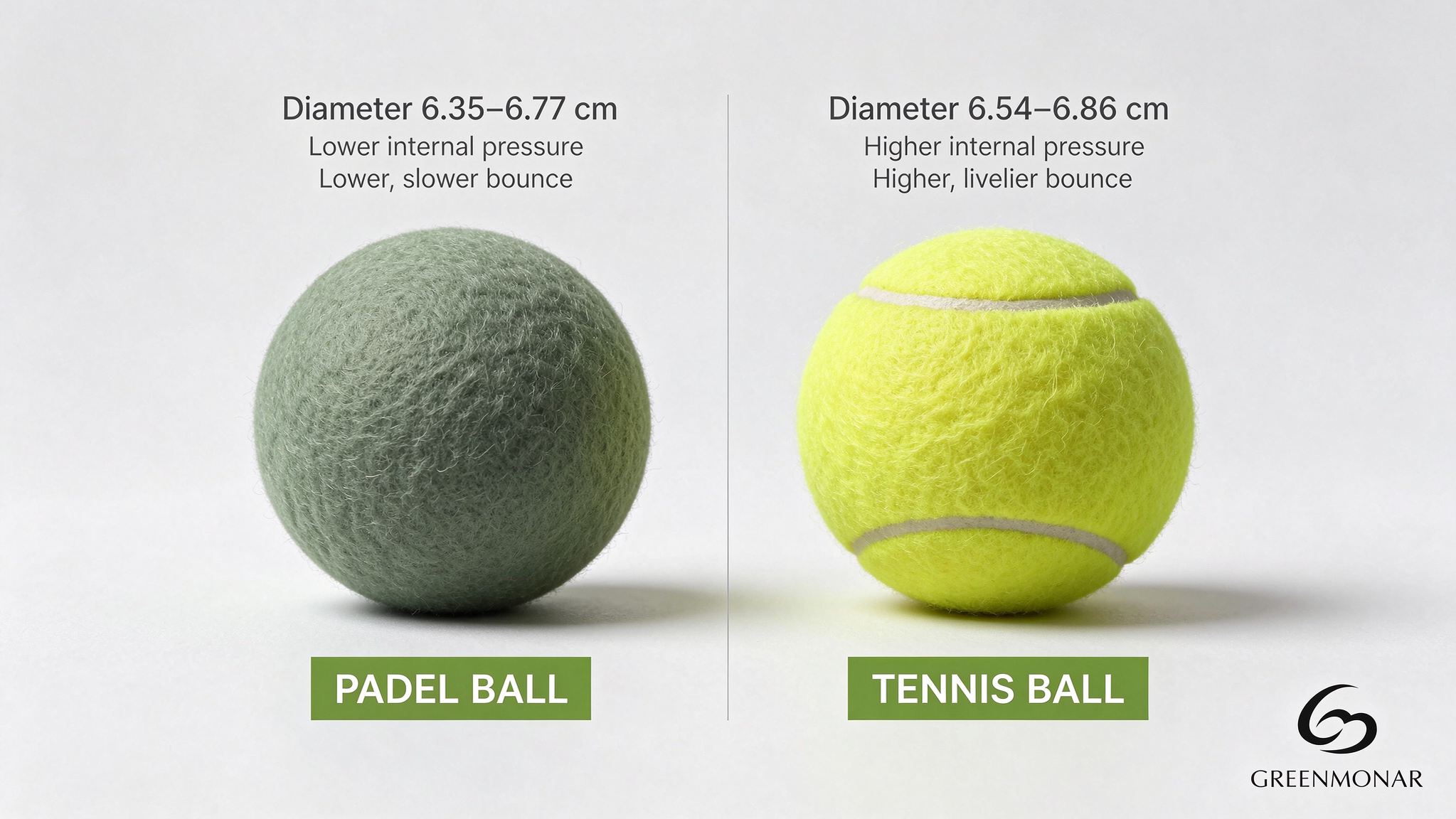
A padel ball is a pressurized rubber-core ball covered in woven felt, designed for the enclosed glass-and-metal courts of padel. Its lower internal pressure keeps the bounce lower and slower, so the ball stays playable after rebounds off the glass walls and mesh fences. The felt is tuned for artificial turf surfaces and repeated wall impacts, helping the ball maintain control through long rallies.
A tennis ball is also a pressurized, felt-covered rubber ball, but it is built at higher internal pressure for open tennis courts. It comes off the racket livelier, bounces higher and travels faster, matching the serve-and-return rhythm of singles and doubles tennis. Felt grades — regular duty and extra duty — are matched to hard, clay or grass surfaces, so the ball wears predictably on different court types.
The table below compares typical specifications of the two ball types. Exact values vary by brand, grade and playing conditions, so always confirm final numbers against the supplier's data sheet before ordering.
|
Feature |
Padel Ball |
Tennis Ball |
|
Diameter |
6.35–6.77 cm |
6.54–6.86 cm |
|
Weight |
approx. 56.0–59.5 g |
approx. 56.0–59.4 g |
|
Internal pressure |
Lower; typical about 10–11.5 psi (4.6–5.2 kg per 2.54 cm²) |
Higher; typical about 14 psi (8.2–10.9 kg per 2.54 cm²) |
|
Bounce (drop from 2.54 m) |
approx. 135–145 cm |
approx. 135–147 cm |
|
On-court feel |
Softer, slower, easier to control off walls |
Livelier, faster, higher bounce |
|
Felt |
Tuned for artificial turf and glass-wall rebounds |
Regular duty / extra duty for hard, clay or grass courts |
|
Best suited for |
Enclosed padel courts |
Open tennis courts |
Fig.2 Side-by-side comparison of padel ball and tennis ball specifications
Internal pressure is the most decisive distinction between the two balls. A padel ball sits at a noticeably lower pressure than a tennis ball, which softens the impact, slows the ball down and keeps the bounce predictable after glass rebounds. A tennis ball holds higher pressure, so it feels livelier off the racket and carries more pace into the rally.
The two balls are nearly the same size, yet the padel ball is slightly smaller, and both sit in a very similar weight range. The small difference in diameter changes how the ball sits on the racket face, while the pressure difference — not the weight — is what mainly changes the feel in play.
Under the standard drop test from 2.54 meters, both balls fall into a similar bounce-height range, but the tennis ball keeps more energy and speed after the bounce, while the padel ball loses pace more quickly. That lower, slower bounce keeps padel rallies playable inside an enclosed court, and supports placement and tactics over raw power.
Both balls use a felt cover over a rubber core, but the felt density and composition are tuned to different surfaces. Padel felt is optimized for artificial turf and repeated wall contact; tennis felt is offered in regular-duty and extra-duty versions to match hard, clay or grass courts. Choosing the wrong felt for a surface can shorten ball life and change flight behavior.
Padel is played against glass walls and mesh fences, so the ball must rebound in a controlled, readable way. The lower-pressure padel ball does this reliably. A higher-pressure tennis ball comes off the glass too quickly and too high, making wall shots harder to read and reducing rally quality.
The short answer: not recommended. Tennis balls hold higher pressure, so they bounce too high and travel too fast off the glass; wall rebounds become unpredictable, and rallies can feel frustrating. They also wear differently on padel turf. Use a proper padel ball for padel, and a proper tennis ball for tennis — matching the ball to the sport protects both player experience and equipment investment.
Xiamen Green Monar Industry & Trading Co., Ltd. is a one-stop sports equipment supply chain based in Xiamen, China. We work with sports brands, padel and tennis clubs, distributors and importers, covering paddles, balls, bags, caps, sunglasses, garments, accessories and court supplies. From product idea and design to forming, assembly and final shipment, our team helps match materials, specifications and packaging to your target market. Send us your product concept, target quantity and market, and our team will reply with catalogs, samples and a quotation.
Nearly, but not identical. Padel balls are slightly smaller (6.35–6.77 cm) than tennis balls (6.54–6.86 cm), while the weight ranges are very close.
Because they are held at lower internal pressure. The lower pressure softens the impact and keeps the bounce lower and slower for wall-based rallies.
It is technically possible, but not recommended. Tennis balls bounce higher and move faster off the glass, making control and scoring unpredictable.
It depends on play frequency, court surface and storage. Once a tube or can is opened, pressure gradually drops; keep balls sealed until use and ask your supplier about shelf-life specifications.
Yes. Green Monar supports OEM/ODM customization across paddles, balls, bags, caps, sunglasses, garments and accessories. Contact Rachel for catalogs, samples and quotations.
Talk to our team for catalogs, samples, OEM/ODM customization and bulk quotations.
Contact: Rachel Lai
Company: Xiamen Green Monar Industry & Trading Co., Ltd.
Email: pickleballsupplychain@gmail.com
WhatsApp / WeChat: +86 136 7590 4019
Web: www.greenmonar.com
Fig.3 Scan the WeChat QR code to contact Rachel at Green Monar
Specification ranges in this article are compiled from publicly available equipment references (padelfans.co.uk, tiendapadelpoint.com, simplepadel.com, padelkoy.com, racketrise.co.uk, vekeda-sports.com). Figures are typical ranges and may vary by brand, grade and playing conditions; always verify final specifications against the supplier's data sheet.